Desk Report:
Commerce Minister Khandaker Abdul Muktadir has said that to make Bangladesh a competitive economy of the future, it is necessary to reduce the complexity of doing business, reduce logistics costs, increase port efficiency and ensure effective use of idle state resources.
He said, “We cannot move forward if we dwell on old problems. Now is the time for practical reforms and rapid implementation of promises.”
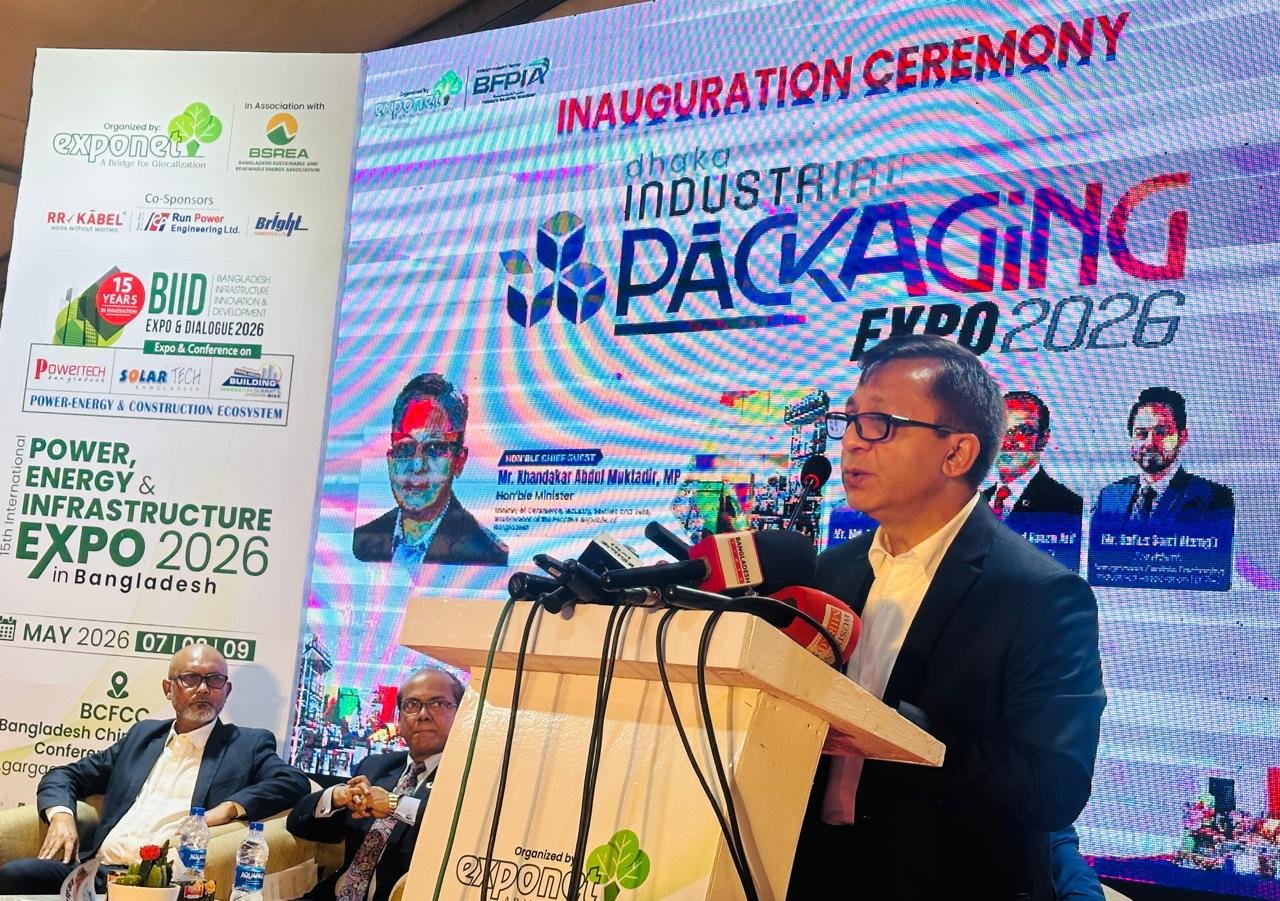
He made these remarks as the chief guest at the inauguration of the Dhaka Industrial Packaging Expo 2026 held at the Bangladesh-China Friendship Conference Center in the capital today, Thursday (May 7, 2026).
The Commerce Minister said that currently, entrepreneurs have to obtain about 25 to 26 types of approvals and licenses to start a business in the country, which has complicated the business environment. In this context, the government is working to simplify the process of starting a business.
He said that in the future, once an organization completes registration through BIDA or the relevant authorities, a “provisional clearance” will be initially given so that entrepreneurs can start their activities quickly.
He said that Bangladesh’s logistics costs are currently about 16 percent of GDP, while the global average is about 10 percent. Due to the lack of efficiency in port management, the cost of transporting goods is increasing and the country is lagging behind in international competition.
To change this situation, internationally recognized foreign operators are being involved. He said that a Danish company has already started working on operating the container terminal and more international quality organizations will be involved in various port activities in the future.
Khandaker Abdul Muktadir said that Bangladesh is on the path to transitioning from an LDC to a developing country. In this reality, there is no scope for a “stop-gap” or temporary solution. Sustainable reform programs must be implemented continuously.
Regarding state-owned industries, the minister said that many large industries have been idle or in loss for years, which is creating huge subsidy pressure on the government. There are about 40 industrial enterprises under the Ministry of Industries and about 50 more under the textile and jute sectors.
The government is gradually opening up the vast land and resources of these enterprises for private investment to bring them under production and employment.
He said, “Our goal is to turn these idle industrial enterprises into centers of investment and employment within the next one to two years. Some will be modernized, some new industries will be developed, and some will create opportunities for export-oriented production.”
As an example, he said, each sugar mill in the country is established on an average of 1,000 bighas or more of land. If modern industrial parks or multifunctional industrial enterprises are established in these places, it will be possible to generate huge investment, employment and revenue for the government.
Referring to the potential of the packaging industry, the Commerce Minister said that the global packaging industry market is huge and Bangladesh needs to move forward with big goals in this sector.
He told entrepreneurs, “You cannot reach big places by thinking small. The government will provide policy and institutional support, but entrepreneurs will have to grow the industry.”
He further said that the government wants the domestic industry to develop, new employment opportunities to be created, Bangladeshi products to gain a stronger position in the international market and to inject new momentum into the economy by increasing export earnings.
Mohammad Hasan Arif, Vice Chairman of the Export Promotion Bureau, spoke as the special guest at the event.
Entrepreneurs, business leaders, representatives of various organizations, including local and foreign stakeholders related to the packaging industry, were present at the event.